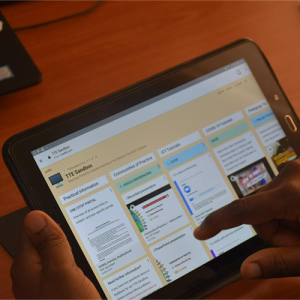
Description
📢 Introduction
In today’s data-driven world, Information and Communication Technology (ICT) for Monitoring and Evaluation (M&E) is revolutionizing how organizations track, assess, and improve program outcomes. This comprehensive 10-day training equips participants with cutting-edge ICT tools and techniques for data collection, analysis, visualization, and reporting in M&E. Participants will learn how to leverage mobile data collection, GIS mapping, dashboards, and cloud-based solutions to enhance decision-making and program effectiveness.
📅 Duration
🕐 10 Days
🎯 Course Level: Intermediate
🎯 Learning Objectives
By the end of this ICT for Monitoring and Evaluation Training Course, participants will be able to:
✔️ Understand the role of ICT in M&E and its benefits for data-driven decision-making
✔️ Implement mobile-based data collection tools such as ODK, KoBoToolbox, and SurveyCTO
✔️ Use data visualization and dashboarding tools like Power BI and Google Data Studio
✔️ Integrate GIS mapping for geospatial analysis in M&E
✔️ Apply cloud-based M&E solutions for real-time data management
✔️ Enhance reporting and presentation skills using ICT tools
✔️ Ensure data security, privacy, and ethical compliance in ICT-based M&E
📌 Module 1: Introduction to ICT for M&E
- Overview of ICT in Monitoring and Evaluation
- Benefits of ICT tools in data management and reporting
- Key ICT innovations transforming M&E
📌 Module 2: Mobile Data Collection for M&E
- Introduction to mobile-based M&E data collection
- Hands-on training with ODK, KoBoToolbox, and SurveyCTO
- Designing and deploying digital survey forms
- Ensuring data accuracy and real-time synchronization
📌 Module 3: Data Management in ICT-Based M&E
- Database management systems for M&E (SQL, Google Sheets, Airtable)
- Cloud-based solutions for real-time data storage and retrieval
- Data integration between mobile collection tools and databases
📌 Module 4: GIS and Mapping for M&E
- Introduction to GIS in Monitoring and Evaluation
- Using Google Earth, ArcGIS, and QGIS for spatial data visualization
- Mapping project impact areas and analyzing geospatial data
📌 Module 5: Data Visualization and Dashboards for M&E
- Introduction to data visualization in M&E
- Creating interactive dashboards using Power BI and Google Data Studio
- Designing effective data reports for stakeholders
📌 Module 6: Advanced Data Analysis for M&E
- Qualitative vs. quantitative data analysis using ICT tools
- Introduction to Excel, SPSS, and R for M&E analytics
- Interpreting M&E data for evidence-based decision-making
📌 Module 7: Cloud-Based ICT Solutions for M&E
- Benefits of cloud-based data storage and security
- Setting up Google Drive, OneDrive, and Dropbox for M&E projects
- Collaborative reporting and real-time data sharing
📌 Module 8: ICT in Real-Time Monitoring and Evaluation
- Implementing real-time M&E dashboards
- Using SMS, mobile apps, and IoT devices for instant data collection
- Automation in M&E processes with AI and machine learning tools
📌 Module 9: ICT for Stakeholder Engagement in M&E
- Using social media and digital platforms for stakeholder communication
- Creating interactive online reports for donor engagement
- Strategies for effective communication and data presentation
📌 Module 10: Ethical Considerations and Future Trends in ICT for M&E
- Ensuring data security, privacy, and compliance
- Addressing challenges in digital M&E implementation
- Emerging technologies in M&E: AI, blockchain, and big data analytics